ICU and You · Le coin français · Number 1
La couveuse
The French of this topic — neonatal intensive care
Neonatal intensive care began in a zoo.
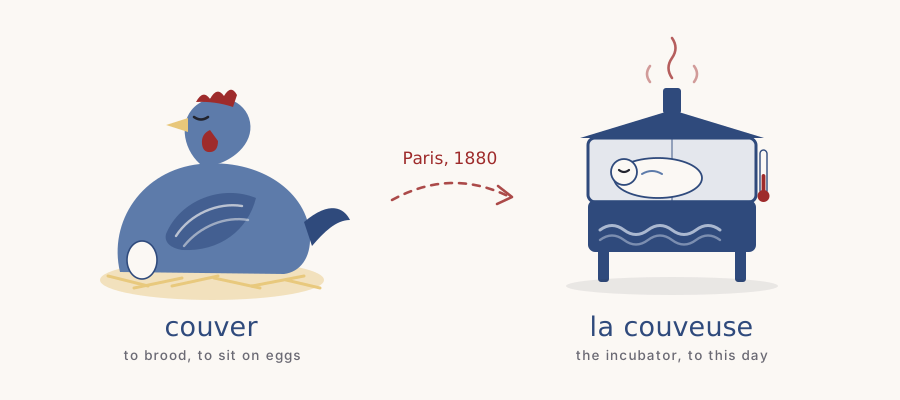
In 1878 Étienne Stéphane Tarnier, an obstetrician at the Maternité de Paris, walked through the Jardin d'Acclimatation and stopped at the poultry house. Odile Martin, who ran it, hatched his chicks in heated chambers. Tarnier had spent a career watching premature infants die of cold, in a profession that regarded prematurity as hopeless, and he asked Martin to build the same apparatus for babies. The first were installed at the Paris Maternité in 1880. Auvard reported in 1883 that mortality had halved.
The French for incubator is still la couveuse — from couver, to brood, to sit on eggs; the root that also gives English covey. The word never let go of the chickens. English reached for Latin instead — incubare, to lie upon — and lost the image entirely. Every French neonatal nurse still says the hens' word a dozen times a shift.
The one that will catch you out
French la réanimation is not resuscitation. It is intensive care. Le service de réanimation is the ICU, and un réanimateur is an intensivist — you.
The act of resuscitation is la réanimation cardio-pulmonaire, but the specialty swallowed the whole word. Worth knowing before you read a French paper and conclude that a patient spent three weeks being resuscitated.
Two words worth the detour
L'ictère. Jaundice comes from Old French jaune, yellow. We borrowed it and kept it; modern French abandoned it and now says ictère, from the Greek. So the English word is French, and the French word is not — which happens more often than you would expect.
Le nourrisson. Budin, Tarnier's pupil, published his lectures in 1900 under that title. It means an infant at the breast: literally, the one being nourished. The feeding sits inside the word, which was exactly Budin's argument — that warmth alone was never going to be enough.
English has no equivalent. Infant descends from infans, not speaking. One language names the baby for what it receives; the other for what it cannot yet do.
Over to you
A French medical word that has caught you out — or one from any other language you work in?
Send it and I will use it. This column runs on other people's collisions with the vocabulary, and the best ones come from whoever last tried to read a paper in a language they half know.
The button opens a reply straight to me. If your device blocks it, write to icuandyou@icloud.com instead.